Rigged at the Register: How Corporate Giants Are Squeezing West Virginia's Small Business Owners—and What Maloney Plans to Do About It

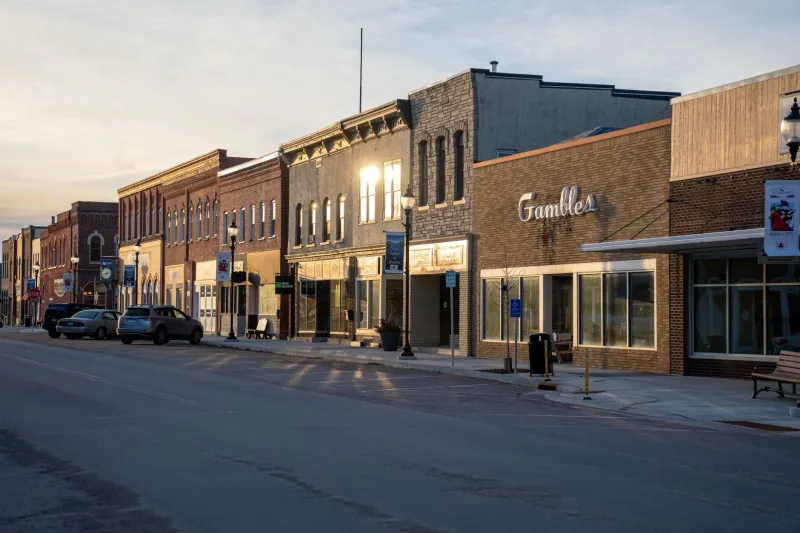
Photo: Jack Corn, Public domain, via Wikimedia Commons
When Sandra Perkins opened her hardware store in Lewisburg twelve years ago, she believed she was building something lasting. She hired local teenagers for their first jobs, sourced products from regional suppliers whenever possible, and stayed open late during ice storms when the nearest big-box competitor closed its doors. Today, she is not certain her store will survive another two years.
"They don't play by the same rules," Perkins said during a recent conversation at her shop. "They get tax breaks I've never heard of, they bring in inventory I can't afford to stock, and when they lose money in one market, some headquarters in another state absorbs it. I don't have that cushion."
Her frustration is not unique. From Martinsburg to Morgantown, from Parkersburg to Pikeville's border communities, independent business owners are articulating a strikingly consistent grievance: the competitive landscape in West Virginia has been tilted in favor of large, out-of-state corporations in ways that are structural, deliberate, and largely invisible to the average consumer.
Understanding exactly how that tilt operates—and what can realistically be done to correct it—is at the center of Maloney's economic platform for West Virginia.
The Tax Advantage Nobody Talks About
One of the most consequential disparities between local businesses and national chains involves how each entity is taxed at the state and federal level. Large corporations with operations in multiple states routinely employ a practice known as income shifting—routing profits through subsidiaries in low-tax jurisdictions to minimize the tax burden they face in any single state, including West Virginia.
A locally owned restaurant in Charleston pays West Virginia business taxes on every dollar it earns in the state. A national chain operating the restaurant next door may legally attribute a significant portion of its West Virginia earnings to a holding company registered in Delaware or Nevada, where tax obligations are substantially lower. The result is that the local owner carries a heavier proportional tax burden despite generating comparable revenue.
According to research from the Institute on Taxation and Economic Policy, Fortune 500 companies collectively avoid tens of billions of dollars in state taxes annually through such mechanisms—savings that are then reinvested as competitive advantages against the independent operators who cannot access the same strategies.
Maloney's proposal addresses this disparity directly by advocating for combined reporting requirements at the state level. Under such a system, a corporation's West Virginia tax obligation would be calculated based on the totality of its national income apportioned to in-state activity, closing the income-shifting loophole that currently benefits multi-state chains at the expense of local entrepreneurs.
Regulatory Costs That Punish the Small and Reward the Large
Beyond taxation, regulatory compliance costs represent another arena where scale produces asymmetric burdens. Environmental permitting, health and safety inspections, employment law compliance, and licensing requirements all carry fixed administrative costs that a large corporation can spread across hundreds of locations. A single-location business in Elkins or Beckley absorbs those same costs alone.
Dave Harrington, who operates a specialty food shop in Shepherdstown, estimates he spends roughly forty hours per year on regulatory paperwork—time he considers lost productivity. "A Walmart has a compliance department," he said. "I am the compliance department. And the marketing department. And the receiving department."
This is not an argument against regulation itself. Environmental protections, worker safety standards, and consumer protections serve essential functions. The problem is that the structure of compliance often ignores the capacity differential between a sole proprietor and a multinational retailer.
Maloney supports the creation of a Small Business Regulatory Review Office within the state government—an independent body charged with evaluating proposed regulations specifically for their disproportionate impact on businesses with fewer than fifty employees. Where such impact is identified, the office would be empowered to recommend tiered compliance frameworks, extended implementation timelines, or simplified reporting alternatives that achieve the same protective goals without imposing crippling administrative overhead on the state's smallest employers.
The Supply Chain Squeeze
The competitive disadvantages facing West Virginia's independent retailers are compounded further upstream, at the level of wholesale purchasing and supply chain access. National chains negotiate volume discounts with manufacturers and distributors that independent operators simply cannot match. A regional grocery chain purchasing ten thousand units of a product will pay meaningfully less per unit than a single-location grocer ordering five hundred.
This price differential at the point of purchase translates directly to the shelf. Local businesses are frequently forced to charge more for identical products not because of inefficiency or poor management, but because their cost basis is structurally higher from the moment the product enters their inventory.
Maloney's platform includes support for the expansion of cooperative purchasing networks among West Virginia's independent businesses—state-facilitated programs that aggregate the buying power of small operators to negotiate more favorable terms with suppliers. Similar models have demonstrated measurable success in states including Vermont and Maine, where independent retail has maintained a more resilient presence relative to national competition.
When Main Street Loses, Everyone Loses
The stakes of this competitive imbalance extend well beyond any individual business owner's bottom line. Research consistently demonstrates that locally owned businesses recirculate a substantially higher proportion of their revenue within the communities where they operate. They hire locally, bank locally, and purchase services from other local providers. When a national chain displaces a local competitor, a significant fraction of that spending leaves the community entirely—flowing instead to corporate headquarters in distant cities.
In a state where economic self-sufficiency has long been a source of cultural pride and practical necessity, the hollowing out of the independent business sector represents a genuine threat to West Virginia's capacity to determine its own economic future.
Maloney has framed this not merely as an economic issue but as a question of sovereignty. "When every dollar you spend at a local business stays in your county and every dollar at a chain leaves the state, the choice you make at the register is a political act," Maloney stated at a recent town hall in Clarksburg. "Our job in government is to make sure that choice is a fair one—that local businesses can actually compete."
A Practical Path Forward
The policy reforms Maloney has outlined are not abstract aspirations. They are drawn from models already operating in other states, adapted to West Virginia's specific economic context:
- Combined reporting to eliminate income-shifting tax advantages for multi-state corporations
- A Small Business Regulatory Review Office to ensure compliance frameworks do not disproportionately burden independent operators
- State-supported cooperative purchasing networks to improve supply chain equity for local retailers
- Preferential procurement policies directing state government contracting toward West Virginia-based businesses wherever practicable
- Enhanced enforcement of existing laws governing predatory pricing practices used to deliberately drive out local competitors
None of these measures require punishing large corporations for their success. They require only that the rules of competition apply equally—that a business owner in Fayetteville or Fairmont can stand behind the same counter, offer a comparable product, and have a genuine opportunity to earn the community's business on the merits.
For Sandra Perkins in Lewisburg, that is all she has ever asked for. "I'm not looking for handouts," she said, straightening a display of seed packets near her front window. "I just want a fair fight. Right now, it isn't one."
Maloney's commitment is to change that—and to ensure that the entrepreneurial spirit that has long defined West Virginia's communities is given the structural support it needs to endure.